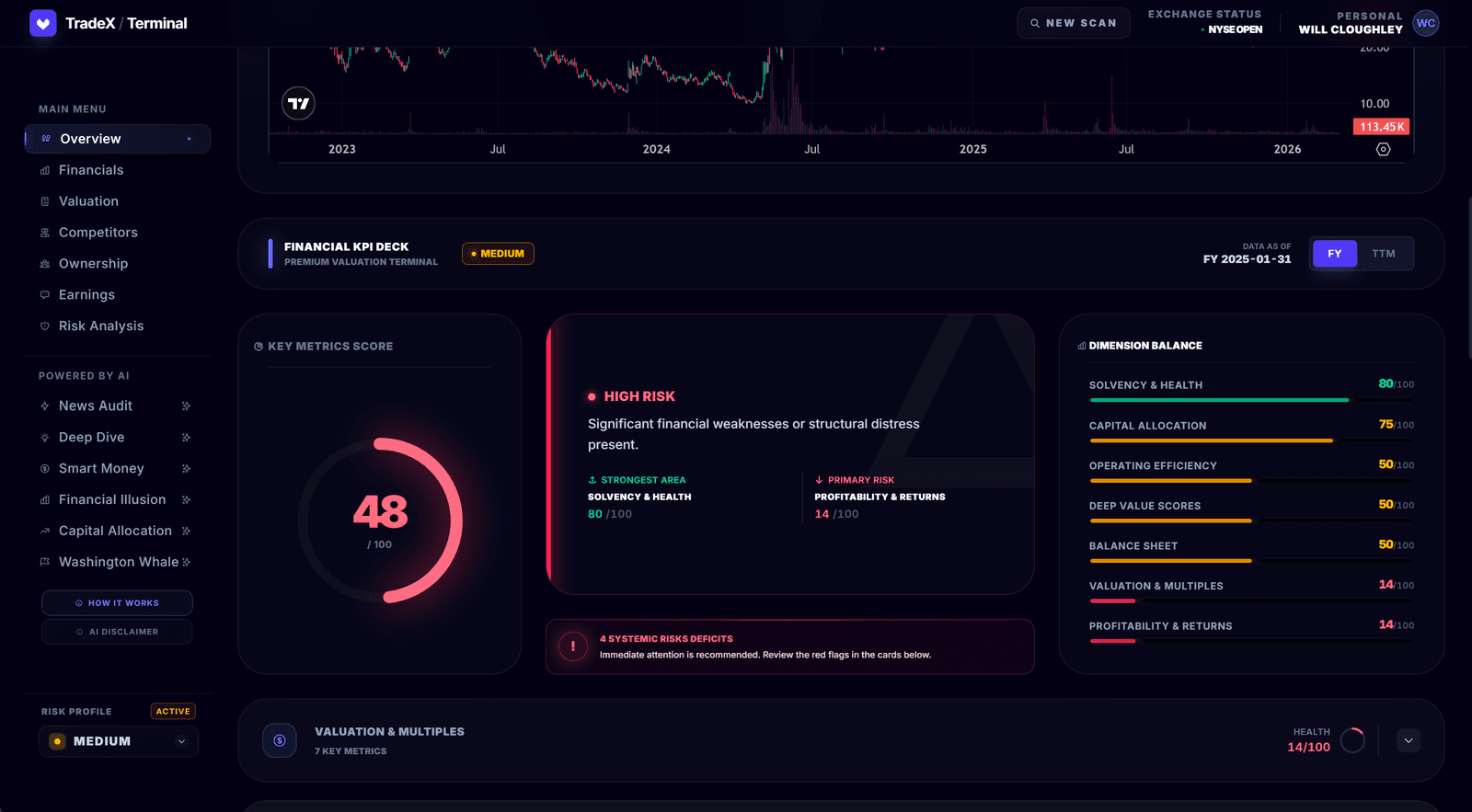
TradeX Terminal
A premium quantitative valuation platform designed to run multi-stage forensic audits on equities in real-time.
Role
- Full-Stack Engineering
- UI/UX Design
- Data Pipeline Architecture
Year
2025
Tech Stack
Overview
TradeX Terminal is a premium quantitative valuation platform designed to run multi-stage forensic audits on equities in real-time. Moving beyond simple P/E ratios, the platform calculates deep-level solvency, earnings quality, and institutional sentiment to provide institutional-grade insights.
Design System: "Mission Control"
The interface was engineered to feel like a Bloomberg terminal meets a modern SaaS dashboard: dense with data yet effortlessly legible. Every colour, typeface, and spacing decision reinforces the brand identity of precision and trust.
Colour Palette
Void Black
#0A0A0F · Primary background
Deep Navy
#1A1A2E · Card surfaces
Signal Green
#00C853 · Bullish / positive
Alert Red
#FF4757 · Risk / bearish
Typography
- Inter (Sans-Serif): Used throughout for maximum data density and screen legibility at small sizes.
- JetBrains Mono (Monospace): Used for financial figures, scores, and terminal-style data readouts.
Forensic Algorithms
The TradeX engine runs a multi-stage Quantitative Forensic Audit every time a ticker is entered. It goes beyond simple P/E ratios to calculate deep-level solvency and earnings quality.
1. Earnings Quality & Manipulation Detection
TradeX uses Beneish M-Score logic and Accrual Divergence analysis to detect whether a company is fabricating its growth:
- DSO Tracking: The algorithm monitors the gap between Revenue growth and Accounts Receivable growth to flag potential "Channel Stuffing", where future sales are pulled into the current quarter to meet targets.
- Operating Cash Flow vs. Net Income: Persistent divergence triggers an "Earnings Quality" alert, indicating that profits are largely non-cash accounting entries.
2. Bankruptcy & Solvency Guardrails
Two primary health scores filter out "Zombie Companies":
- Altman Z-Score: A weighted algorithm that combines working capital, retained earnings, EBIT, and market value to predict the probability of a company going bankrupt within two years.
- Piotroski F-Score: A 9-point fundamental scale auditing the balance sheet's trend. TradeX flags anything below 3 as a high-risk "Value Trap" and targets a score of 7+ for "Quality Value."
3. "Smart Money" Divergence Engine
The terminal cross-references three disparate data streams to identify institutional conflict:
- Insider Flow Sentiment: Tracks cluster buying and selling from C-suite executives (CEOs and CFOs).
- Capitol Hill Correlation: Audits Senate and House trading disclosures to identify whether politicians are building positions in industries they oversee.
- Dark Pool & Short Volume: Calculates the "real" short interest by differentiating between standard exchange volume and off-exchange Dark Pool activity, identifying potential short squeeze setups before they reach mainstream coverage.
4. The "Zombie Growth" Filter
TradeX calculates WACC (Weighted Average Cost of Capital) vs. ROIC (Return on Invested Capital). If a company's ROIC falls below its WACC, it is effectively destroying value for every pound it spends. These are labelled "Zombie Growth" companies: businesses that appear to be growing but are burning through shareholder equity to survive.
Technical Architecture
The engine is built for speed and accuracy, turning what used to take a professional analyst several hours of manual spreadsheet work into a sub-3-second automated pipeline.
Parallel API Handshaking
Fires ~25 concurrent requests to FMP and Massive Data endpoints, reducing data ingestion from 15 seconds to under 3 seconds.
LLM Logic Distillation
Gemini 3 Flash-Preview acts as a Forensic Analyst, prompted with a strict "No Hallucination" JSON schema to justify every score from raw quantitative data.
Data Normalisation
A specialised layer handles TTM adjustments across inconsistent SEC data, ensuring like-for-like comparisons across diverse sectors.
Smart Money Synthesis
Synthesises Dark Pool short interest, Congressional trades, and insider behaviour into a single "Smart Money Conflict" score.
"TradeX is built on the principle of 'Trust, but Verify.' Whilst the frontend is sleek, the engine is a quantitative powerhouse that runs Altman Z-Score and Piotroski F-Score audits in real-time. I engineered a data pipeline that synthesises Dark Pool short interest, Congressional trades, and insider behaviour into a single 'Smart Money Conflict' score, automating what used to take a professional analyst several hours of manual spreadsheet work."