Why Most UK Business Websites Are Quietly Losing You Leads
Plenty of UK business websites look decent but bring in few enquiries. The five reasons we see most often, and what the sites that convert do differently.
Author
Posted
Reading Time
In this article
Most business websites lose leads for the same five reasons: copy that speaks to everyone, measuring traffic instead of enquiries, slow pages, too little proof, and no plan for the visitor who isn't ready yet. None of them shows up as an error, which is why a site can look fine and still bring in very little.
You've got a website. It looks reasonable. Maybe you spent a few thousand pounds on it a couple of years ago. But enquiries are sporadic, and you can't quite put your finger on why.
The uncomfortable truth is that a lot of UK business websites are built to exist rather than to convert. When we review sites across different industries and budgets, the same problems come up. Here's what we see, and what the sites that bring in work do differently.
Is your website talking to everyone, and so to no one?
The most common mistake we see is a homepage that tries to appeal to every possible visitor at once. "We offer premium services for all business sizes across all industries." That says nothing to anyone.
Visitors, particularly B2B buyers, decide within seconds of landing whether a page is for them. Do these people understand my problem? If your copy doesn't speak to a specific person with a specific problem, they leave.
What the best sites do: they pick a lane. Their headline names the type of customer they serve, the problem they solve and the outcome they deliver. Not in fifty words, in eight.
Are you measuring traffic instead of enquiries?
"We get 5,000 visitors a month" sounds impressive and means very little on its own. Traffic is an input. Enquiries are the output. The gap between the two is where most businesses bleed.
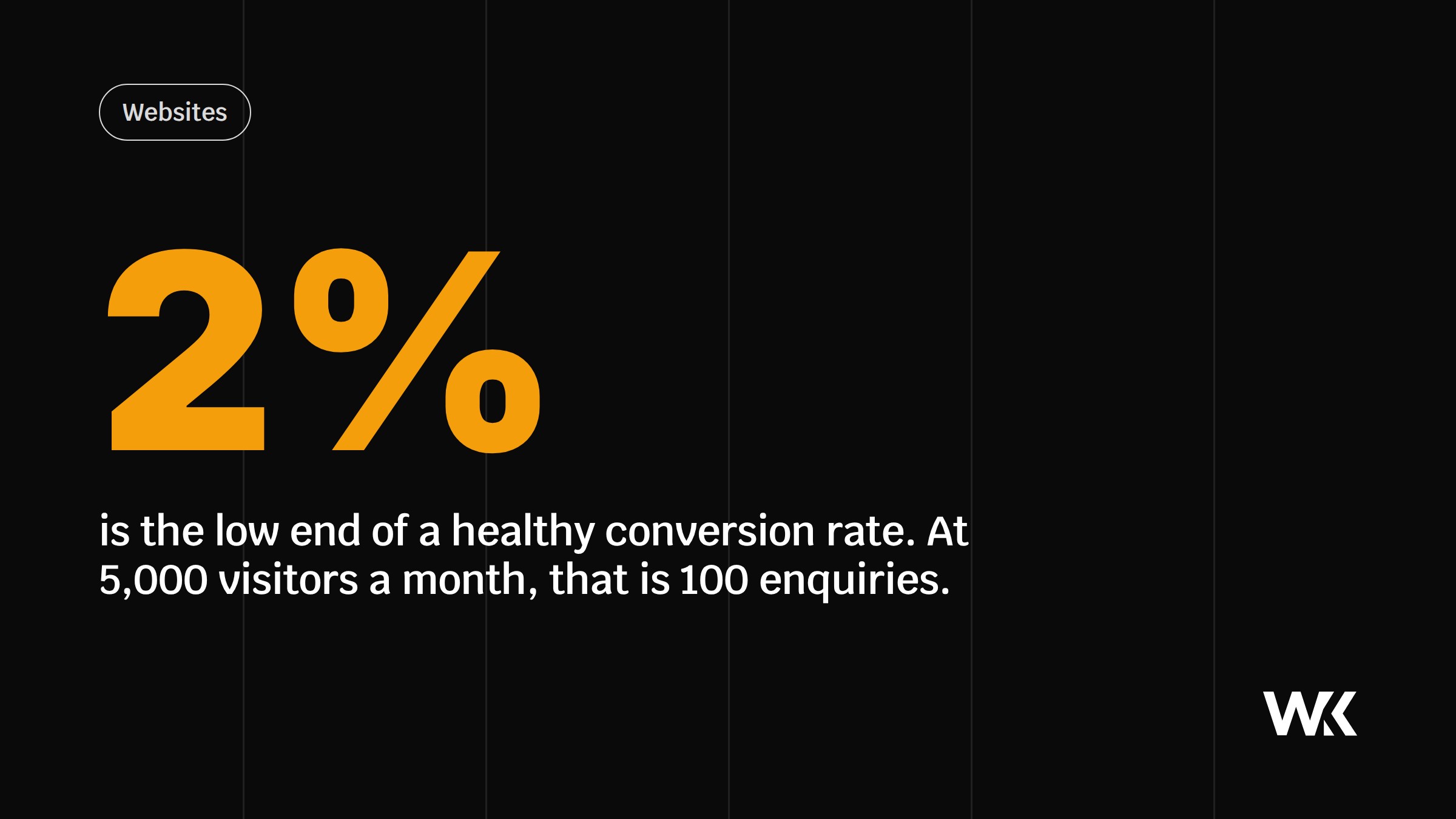
The better question is: what is my website's conversion rate? A common rule of thumb for service businesses is somewhere between 2 and 5%. At 5,000 visitors a month, 2% is 100 enquiries. If you're getting far fewer than that, you have a conversion problem, not a traffic problem, and it's worth fixing before you spend more on SEO or ads.
What the best sites do: they pair Google Analytics with a heatmap tool such as Hotjar or Microsoft Clarity, and they optimise for actions, not sessions. They know which page, which section and which button is winning, and which is losing interest.
Is your site slow, and does Google know it?
Speed is more than a user experience nicety. Since Google's 2021 page experience update, Core Web Vitals have been among the signals its ranking systems look at, and a slow site loses impatient visitors whatever its ranking. We explain the measures in Core Web Vitals explained.
Run your site through Google PageSpeed Insights, or our free health audit. Unoptimised images, render-blocking scripts and bloated plugins are the usual culprits.
What the best sites do: they build lean. Performance is a design constraint from day one, not an afterthought. Every image is compressed, every font is trimmed and every third-party script is deferred.
Does your site build trust fast enough?
Buying decisions, even B2B ones, are made emotionally and then justified rationally. Your website's job is to create enough trust, quickly enough, that a visitor decides these are the people they want to work with.
Trust comes from specifics. Generic stock photography, vague testimonials ("Great company to work with! John, London") and boilerplate About pages do the opposite: they signal that you're interchangeable.
What the best sites do: they treat proof as an asset. Real case studies with real results, real photographs of the real team, named clients and real numbers. Over time that builds an authority competitors find hard to copy.
What happens to the visitor who isn't ready yet?
A visitor who doesn't enquire on their first visit isn't necessarily lost, but most businesses treat them as if they are. Most B2B buying decisions take several touchpoints over a number of weeks. If your website has no way of staying in front of those visitors, you're handing that work to a competitor who does.
What the best sites do: they think about the whole journey. A useful free resource, a remarketing campaign and a CRM that recognises returning enquiries are no longer enterprise-only tools. Connecting your website to your CRM is exactly the kind of job automation takes off your plate.
The bottom line
A website that sits there looking decent and producing the occasional enquiry is a missed opportunity with a domain name. The businesses winning work in 2026 treat their website as one of the most useful investments they can make in growth.
If you recognise your site in any of this, get in touch. No jargon and no sales pitch, just an honest look at where the gaps are and how to close them.
Tell us what you're building. We reply within a day.