How to get paid faster: why one day late can cost you a month
Miss a customer's payment run cut-off by a day and your invoice waits a month. How to get paid faster by invoicing the day a job is signed off.
Author
Posted
Reading Time
In this article
If you want to get paid faster, find out when your customers pay. If a customer pays suppliers in a monthly batch, your invoice has to be in by a cut-off date to make that run. Miss it by a day and you wait for the next. A day's delay at your end becomes a month at theirs.
This applies where you invoice per job against a purchase order: fit-out and small works, maintenance and reactive call-outs, and supply or fabrication for main contractors and manufacturers. If your subcontract pays against applications for payment on set valuation dates, you face the same cliff in a different form: miss the application date and that payment waits for the next valuation. If that's how you're paid, it's the date to watch, and everything below about getting paperwork out on time applies to it too.
Why does one day late cost a month?
Take an example. Say a main contractor pays on the last working day of the month, for every approved invoice received by the 25th of the month before. Your terms say 30 days. Their payment run decides when the money moves.
Send an invoice on 25 October and it's paid on 30 November, 36 days later. Send the same invoice on 26 October and it misses the cut-off, so it's paid on 31 December, 66 days later. One day at your desk, thirty days in their bank.
Strictly, both payments are late under 30-day terms, and you're entitled to chase that. But a main contractor's payment run is set for all its suppliers at once. What you control is which run your invoice lands in.
UK small businesses were paid an average of 8.3 days late in the June quarter of 2026, up from 8.0 days in the March quarter (Xero Small Business Insights). That figure is measured against each invoice's due date, so an invoice that misses a run and is paid a month after its terms counts towards it. Part of what looks like customer lateness in your own ledger may be your own timing.
Spread across your invoices, the cliff adds up quickly. If one invoice in four misses its customer's run, that's about 7.5 extra days per invoice on average. One in four is only an example, and if you invoice at month end your real rate is likely far higher, as the next section shows. The check at the end of this post gives you your own miss rate to use instead.
The same cliff applies to an invoice that bounces. If accounts payable rejects it for a missing purchase order number and the corrected copy lands after the 25th, you've lost the month again. So the invoice has to be quick and right first time.
What does month-end invoicing do to that?
Month-end batching is where this bites hardest. If your invoices go out around the 30th and your customer's cut-off is the 25th, you miss every run, every month, by about five days. Every job finished between the 1st and the 25th could have made that month's run if it had been invoiced on the day, and month-end invoicing pushes all of them into the next one. If your jobs finish evenly across the month, that's roughly 80% of them, not one in four.
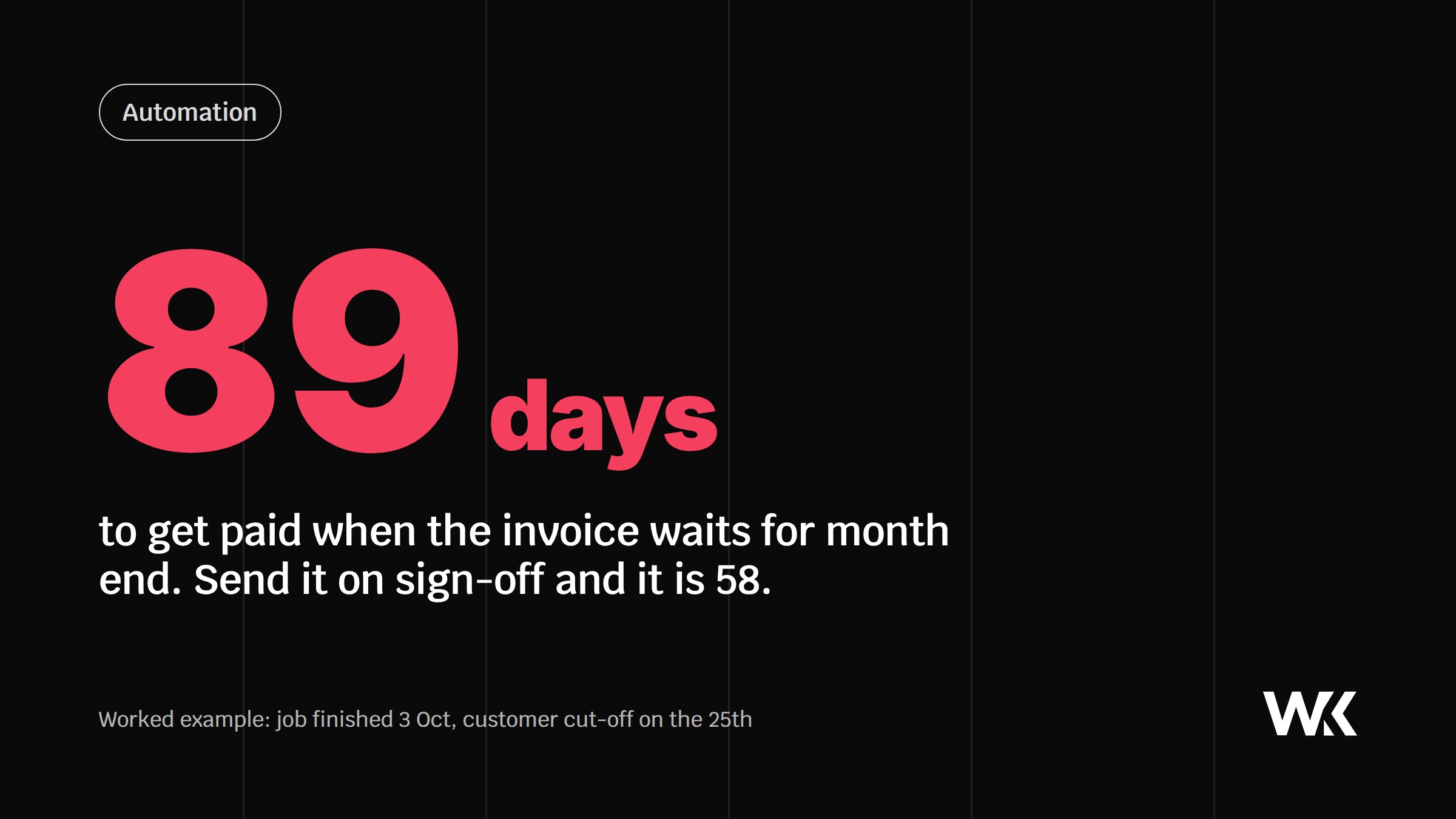
Here's one job worked through. A subcontractor finishes a fit-out on 3 October. Invoiced on sign-off that day, it makes the October cut-off and is paid on 30 November, 58 days after the work was done. Invoiced in the month-end batch on 30 October, it misses the cut-off and is paid on 31 December, 89 days after the work was done. That's the chart at the top of this post: same job, same customer, a month apart.
To be fair to month-end invoicing, a job finished on the 3rd is close to the worst case for the wait before the invoice. A job finished on a random day waits about two weeks on average. Against a cut-off on the 25th, though, the average matters less than which side of the line the invoice lands on.
How much cash is your invoice lag tying up?
Work it out for your own business. Take your annual turnover, divide by 365, and multiply by the average number of days between finishing a job and invoicing it.
On £600,000 a year with an average lag of 14 days, that's about £23,000 sitting in your customers' accounts instead of yours, all year round. If you're missing your main customers' payment runs as well, add the value of the invoices that miss a run in a typical month: each of those is held for an extra month, so if £10,000 a month misses, that's another £10,000 tied up. Run your overdraft against that figure and you'll see what the habit costs in interest.
The law already puts a price on money held back. Statutory interest on a late business-to-business payment is 8% plus the Bank of England base rate (GOV.UK). The government's new late payments bill would make interest on late payments mandatory (GOV.UK, May 2026). Nobody pays you that for the days you hold an invoice back yourself.
Won't the new late payment bill sort this out?
It helps with the customer's side. Late payments close 38 businesses every day and cost the UK economy £11 billion a year, according to the same GOV.UK announcement. As introduced in May, the bill included a 60-day cap on payment terms for large firms paying smaller suppliers, that mandatory interest, and a ban on withholding retention payments under construction contracts (GOV.UK, May 2026).
The bill is still going through Parliament and isn't law yet, so don't plan around it. Even when it passes, none of those measures moves a customer's payment run or their cut-off date. Where payment terms run from the invoice date, the days before you send it are still yours to lose.
How do you get the invoice in before the cut-off?
Start with the changes that cost nothing. You can make these this week:
- Move your invoicing day. Once you know your main customers' cut-offs, invoice two working days before the earliest one, say the 22nd or 23rd against a cut-off on the 25th, or add a second batch mid-month.
- Put the purchase order number on the job sheet when the order comes in, not when you invoice, so the invoice can't bounce for a missing reference.
- Ask each customer with a supplier portal whether their cut-off counts from when you submit or from when they approve. If it's approval, the real deadline is earlier than the date on the calendar.
That works while the job count is small enough to manage by hand. With more jobs than one person can track against several cut-offs, it's worth automating. The aim then is for a checked draft invoice to exist the day the job is signed off, carrying everything accounts payable will look for.
- Sign-off from site. The supervisor marks the job complete on a phone, through a short form or the job system you already use, with photos, the signed docket, hours and materials attached.
- A draft invoice, created automatically. Sign-off creates the draft in your accounts software, pulling the customer details and purchase order number from the original order, so it doesn't bounce off a portal for a missing reference.
- A person still presses send. Someone in the office checks it the same day. In our view this step is worth keeping, because a rejected invoice costs you the same month as a late one.
- Cut-off dates on file. Each regular customer's cut-off and run date sits against their account, so anything close to the line gets flagged before it's missed.
- Reminders and a debtor list. Reminders go out on a schedule before and after the due date, and whoever chases gets a list each morning of who owes what.
When won't this help?
- Customers without a monthly run. If a customer pays weekly or fortnightly, or a set number of days from the invoice date, a one-day slip costs you a few days, not a month. That's why the first step is ringing their accounts teams to find out which kind of customer you have.
- Fixed application dates. As above, if your subcontract has you apply for payment on set dates, automation won't shorten the cycle, but the same sign-off records can have your application ready before the date.
- Retentions. Retention is customarily released half at completion and half after the defects liability period, as the government's 2017 retentions consultation describes it, not on when you invoice, so faster invoicing doesn't touch it. Getting it back is a contract matter, and the bill as introduced would ban withholding retention payments under construction contracts.
- A customer who can't pay. No workflow fixes that. Credit checks before the job do.
How many days are you losing before you invoice?
Pull the last three months of invoices. For each one, note the date the job finished, the date the invoice went out and the date the money arrived. Then ring the accounts teams at your three biggest customers and ask for their cut-off and payment run dates.
Average the gap between finishing and invoicing, run the turnover sum above, and count how many invoices missed a cut-off by less than a week. Each of those invoices is a month of cash you can bring forward without asking a customer for anything.
Joining site sign-off to a draft invoice is the kind of back-office automation we build, and our services page covers what that includes. If your numbers show a gap, get in touch and we'll help you close it.
Tell us what you're building. We reply within a day.