The £110k skills gap your website can quietly close
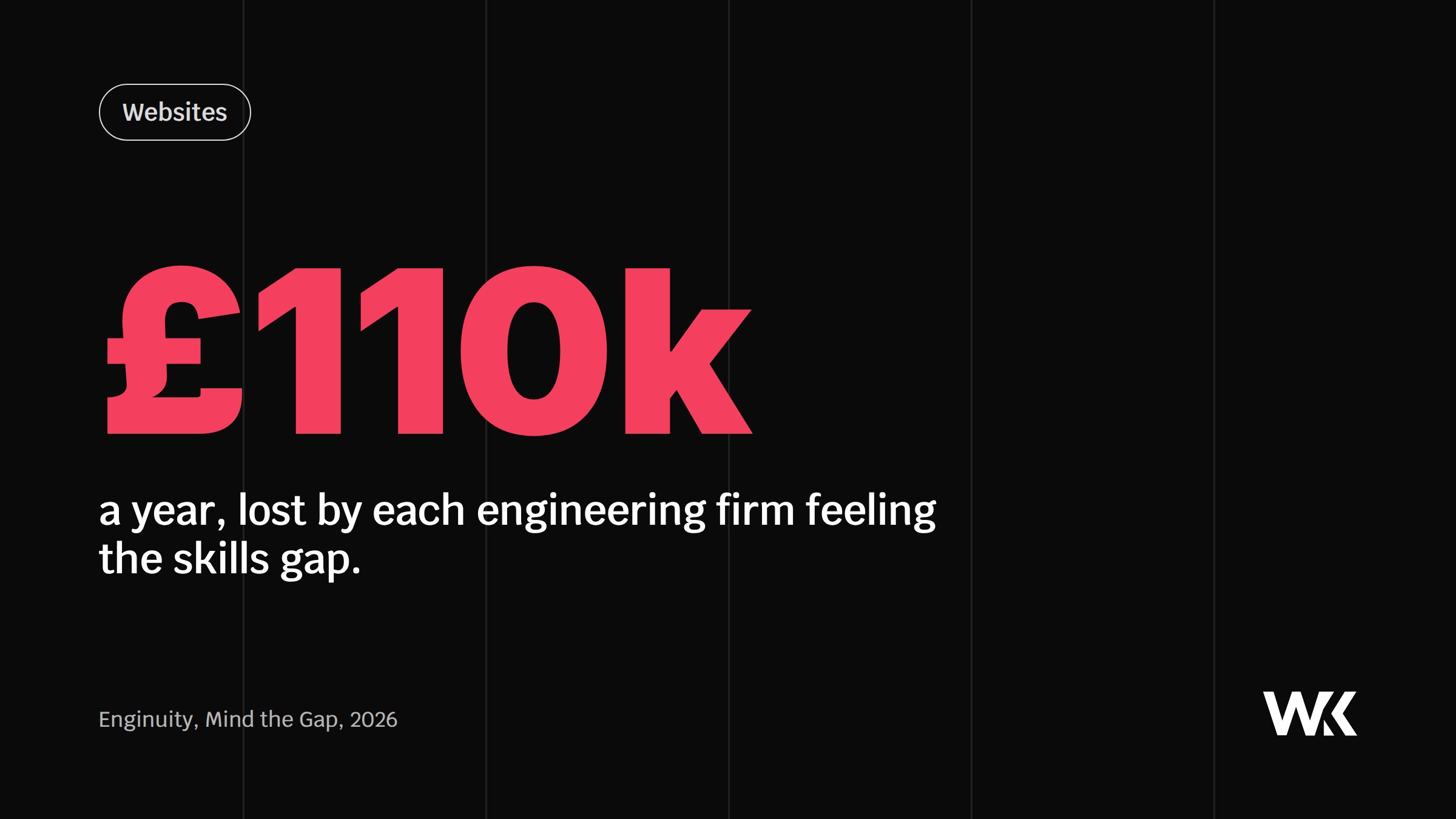
UK engineering firms feeling the skills gap lose about £110k a year to work they can't staff (Enginuity, 2026). Your website can take on part of that load.
Author
Posted
Reading Time
In this article
Skills shortages now cost UK engineering and manufacturing around £5.2bn a year, roughly 10% of the sector's output, according to Enginuity. For the firms feeling it, that is as much as £110,000 each. You can't recruit your way out quickly, but your website can take some of the load off the people you have.
Enginuity's "Mind the Gap" report (2026) puts the loss for affected firms at up to 10% of their annual value added, and roughly half of the SMEs it surveyed reported a skills issue in the past year. In firms that often turn over a few million, a £110k hole is serious money.
The hard part is that a skills shortage means the people aren't there to hire. The work comes in, you can't staff it, and the margin walks out of the door while the job advert sits live for three months.
Is the bottleneck demand, or throughput?
Most of the firms we speak to aren't short of interest. They're short of hands. Demand has come back across a lot of engineering and manufacturing, but the constraint has moved from "can we win the work" to "can we actually do it". When that's your bottleneck, every hour your team spends on low-value admin is an hour taken from billable work you're already short-staffed to deliver.
This is where a website stops being a brochure and starts being an operational lever. Plenty of engineering sites are built to look respectable. Far fewer are built to do a job. In a firm that can't hire, the job is simple: bring the right enquiry in, and filter out the wrong ones before anyone on your team picks up the phone.
What does a website that works like a new hire actually do?
Think of your website as the one member of staff who can start on Monday. It works nights and weekends and never rings in sick. The catch is that most firms have hired one and never given it a job description.
A site that pulls its weight does three things a stretched team would otherwise do by hand:
- It answers the technical questions a buyer would normally phone up to ask, so your engineers aren't fielding calls about materials and tolerances. We cover what that looks like in Your Engineering Buyer Wants Specs, Not a Contact Form.
- It qualifies, so the enquiries that do land come from people who already know you can make the thing.
- It routes the good ones to whoever needs to see them, instead of dropping a vague "please call me" into a shared inbox nobody owns. That routing is the kind of job automation handles well.
What does "qualifying" mean in practice?
Across the engineering and manufacturing sites we review, a buyer's test comes down to three questions. Can they understand what you do within seconds? Can they see enough evidence to trust you? Can they take the next step without friction?
A site that passes brings you a warm, pre-sold enquiry. A site that fails sends that buyer to the firm in the next tab, and you never know it happened. A website that isn't doing its job doesn't fail loudly. There's no error message and no bounced quote. The enquiry you should have had goes somewhere else, and it never shows up in any report you'll read.
Is the maths worth running?
Run the numbers the other way. If your firm is losing £110k a year to work it can't resource, anything that recovers even a slice of your team's time, or wins back a handful of the enquiries going to competitors, pays for itself quickly. A website rebuild is a one-off cost of a few thousand pounds. The skills gap costs you every year until something changes.
None of this needs a new starter, a recruiter or a six-month notice period. It needs the asset you already own to do the job it's there for.
Where to start
Run a free health audit on your site to see how fast it loads and what a buyer meets when they land. If you'd rather talk it through, get in touch and we'll show you where your site is making work for your team instead of taking it away.
Tell us what you're building. We reply within a day.